
The Woven Homer
Men’s Song and Women’s Weaving at the Panathenaea

By Eirene S. Allen
By Eirene S. Allen
Most of us meet Homer on the page: a thick paperback from a college course, or an elegant new translation promising to enliven the epics for modern readers. Framed this way, Homer appears as a fixed thing: an ancient poet, perhaps blind, dictating two monumental texts that later generations try to reproduce as “faithfully” as possible, or not. Debates over translation usually follow from these assumptions that Homer was a poet and his epics were texts: Which version best captures the original Greek? Which preserves the meter, the tone, the grandeur, the themes?
Even if we speak of Homer as a single poet, ancient sources do not present him as the author of fixed books, and his epics were not “poems” in our modern, text‑bound sense. Long before the Iliad and the Odyssey became books on a shelf, they belonged to a living civic and religious world: festivals, processions, sacrifices, competitions, and ritual labor. They were shaped not only by singers and audiences, but also by the city that organized their performance and by the women whose work helped make that performance possible.
The scholarship of Gregory Nagy invites us to imagine Homer in that ancient setting. In his account, the epics come to life not in the hands or voice of a solitary poet, but on a sacred day in Athens: streets full of dust and flute music, the scents of animals and incense, a procession climbing toward the Acropolis with sacrifices and a new robe for the city’s protecting goddess. For months leading up to this day, women have worked at their looms, weaving that great garment in which the city will clothe their goddess. On the day itself, professional performers recite epic in competition, each continuing the story where the previous singer left off.
In Nagy’s account, the Iliad and the Odyssey are inseparable from this ritual world. The epics were not simply stories that happened to be written down. They were performances embedded within the Panathenaea, the great Athenian festival of their patron goddess, Athena. On those days the city staged contests of mousikē, encompassing music and verse, in which rhapsodes competed by reciting Homer “in sequence” and “by relay,” each taking up the song where the previous singer left off. The same officials who oversaw those contests also supervised the weaving of Athena’s new robe and the sacrifices offered at her altar. Homeric epic, in other words, was woven into a festival that interlaced public performance, civic regulation, sacred procession, and textile labor, much as threads on a loom are drawn together into a single patterned cloth.
Seeing Homer in this context reframes the stakes of translation and adaptation. A version that preserves the plot and something like the music of Homer’s meter may be doing important work, but it is partial work. The epics are not just poems but historical artifacts, fragments of lived, sacred events. They were made and remade in public, before a particular community, and in a ritual setting that needed both male performance and female labor.
Nagy’s argument begins with a deceptively familiar word: humnos, “hymn.” Modern readers tend to imagine a hymn as a short song of praise directed toward a god. Nagy argues that in archaic Greek usage, the term is not only richer but also more technical. A humnos is an “authoritative beginning” that makes a whole performance possible. It is the starting edge that gives the rest of the song something to attach to. Once a singer has begun by invoking a god, everything that follows can still belong to that same humnos.
To explain this, Nagy turns to weaving. The vocabulary around humnos belongs to the same cluster of terms used for textile work, and the Greek word rhapsōidos, “rhapsode,” literally means “stitcher of song,” someone who sews verses together. The analogy becomes clearer if we imagine a warp‑weighted loom: everything depends on the fixed starting edge from which the fabric grows. Without that anchoring band, the pattern cannot hold, but once it is in place, the cloth can expand indefinitely. A humnos works the same way. It creates a starting edge that allows a larger web of song to unfold, as one performer picks up where another leaves off, and verses attach to earlier verses. Homeric epic, then, is not a piece of writing that stands alone but a woven continuum of performance, stitched together by rhapsodes before the city, just as Athenian women bind threads into a woven surface at their looms.
According to Nagy, this performance system helped shape the unity of the epics themselves. The Iliad and the Odyssey became, in effect, one vast ceremonial humnos to Athena, continuously restitched in performance as a gift to her at the Panathenaea. Homer was not simply composed. Homer was repeatedly reassembled before the city.
But the Panathenaea was not only heard; it was also seen. Alongside the performances of the rhapsodes stood another monumental act of labor: the aforementioned making of Athena’s Peplos, the great woven robe presented to the goddess during the festival procession. Athenian women spent months producing this Peplos, weaving into it images of the gigantomachy, the battle between the gods and the Giants in which Athena appears as the defender of cosmic order. Ancient descriptions and modern textile scholarship suggest that the robe functioned almost like a narrative frieze in cloth: myth rendered in dyed wool and pattern.
The parallels with epic are difficult to miss. While male performers stitched together a monumental song for Athena, women wove a monumental textile that carried myths of her battles and victories across its surface. Both offerings moved through the same sacred space. Both transformed stories into public display. Both helped define Athens itself. The city heard Homer while it watched Athena be clothed in myth.
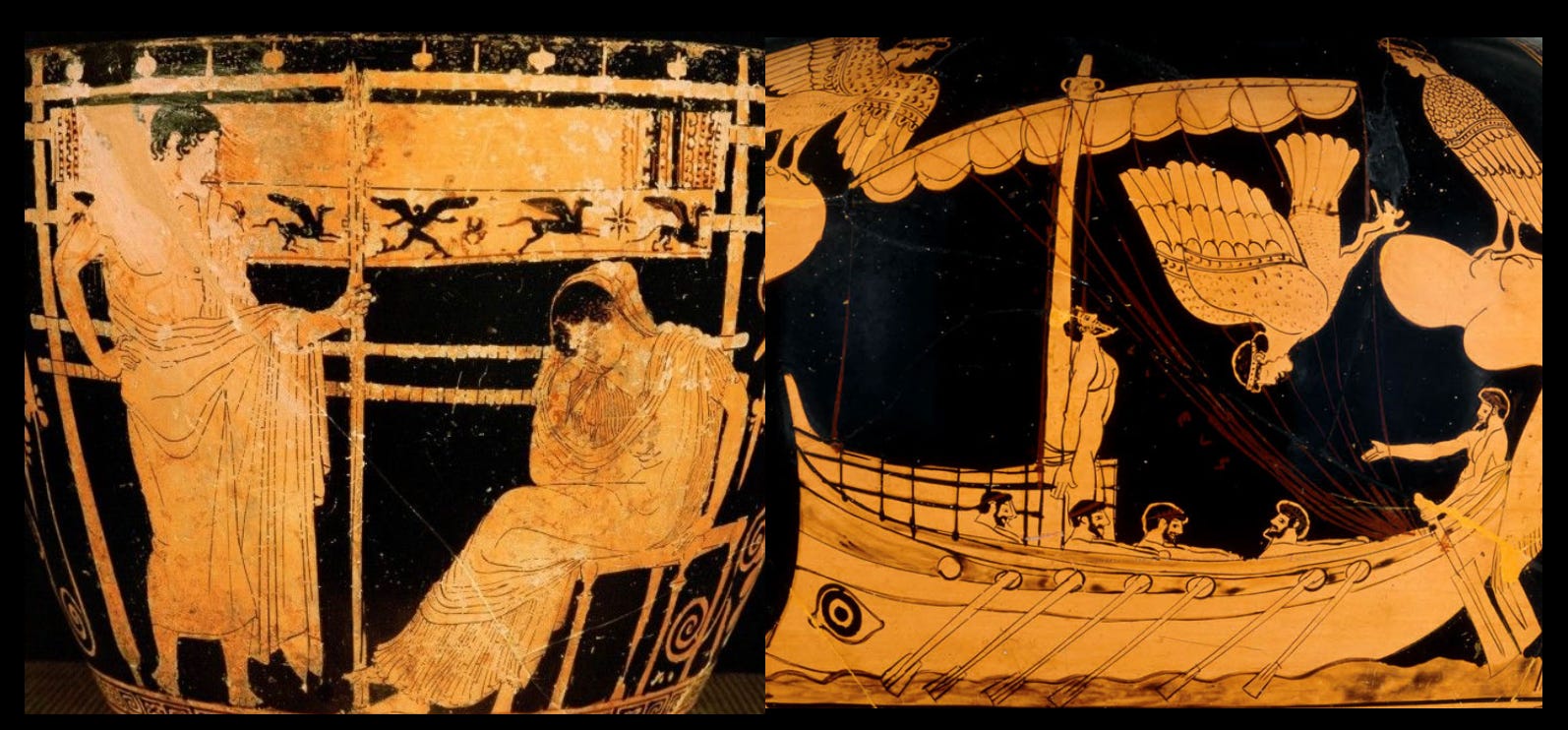
This is not just poetic metaphor. Textile work and storytelling belonged to the same symbolic world. Greek literature repeatedly connects women’s weaving with acts of narrative crafting. In the Iliad, Helen weaves scenes of war into patterned cloth. In the Odyssey, Penelope’s weaving and unweaving of Laertes’ shroud does more than simply symbolize patience or fidelity; it controls time itself, delaying closure until Odysseus returns. Read against the backdrop of the Panathenaea, such scenes look less like decorative domestic set-pieces of silent women doing “mere” women’s work and more like reflections of a larger cultural system. Women’s textile labor participates directly in the creation, preservation, and suspension of narrative memory.
This is the world that disappears in modern adaptations of Homer. Contemporary retellings may boldly reinterpret the epics. They may shift perspectives, compress events, modernize psychology, or foreground voices they perceive as marginalized within the poems. But when Homer becomes just a timeless adventure story about individual experience, the historical world that once shaped the epics begins to vanish. And when the Panathenaic festival and Homer as a civic performance disappear, so do the women whose weaving clothed the goddess in myths that ran alongside, and helped frame, the epic stories men were singing.
None of this obliges translators or filmmakers to reproduce the Panathenaic procession frame by frame. But Nagy’s work does complicate what we mean by “fidelity.” The “original” Homer was never simply a sequence of events preserved in verse and text. It was a fabric of performances, rituals, and crafts unfolding within the sacred life of a city. Any time a new Iliad or Odyssey is praised as “accurate,” it is worth asking: accurate to what? To the plot? To the tone of heroic speech? To the meter of Homeric verse? Or to the older reality in which epic song, civic ritual, and women’s weaving formed part of the same cultural act?
To forget that woven world is not merely to simplify Homer. It is to transform him. The shift from festival performance to freestanding story changes what the epics are allowed to remember and whose labor remains visible within them.
For Further Reading:
Homer
The passages referenced below suggest that Homeric poetry already imagines textiles, temples, and song within the same symbolic world.
Iliad 3.121–128: Helen at her loom, weaving “the many struggles” of Trojans and Achaeans into a dark, gleaming cloth.
Iliad 9.185-191: Achilles singing kléa andrõn, “the famous deeds of men,” to the lyre while Patroclus sits waiting for him to “leave off” singing.
Iliad 22.437–441: Andromache at her loom, hearing wailing from the walls interrupts her weaving.
Odyssey 2.94–110; 19.137–184; 24.128–147: Three mentions of Penelope’s weaving and unweaving Laertes’ shroud, where her textile work structures and delays the poem’s narrative time.
Odyssey 7.80–81; 13.187–188: Athena in relation to the palace of Erechtheus, the mythical early king of Athens, and the city of Athens, a rare Homeric glimpse of Athena as city-goddess that later Panathenaic traditions build on.
Plato
Plato, Ion. A short dialogue centered on a professional rhapsode of Homer, exploring rhapsodic performance, inspiration, and expertise.
Plato, Republic 2–3 (esp. 376e–403c). Critique of Homer as civic educator and reflections on poetry, mimesis, and the shaping of citizens.
Plato, Timaeus and Critias (openings). Framed as a coordinated “set” of speeches that echo rhapsodic sequencing and Panathenaic-style epic performance.
Secondary Sources
Gregory Nagy, Plato’s Rhapsody and Homer’s Music: The Poetics of the Panathenaic Festival in Classical Athens (Center for Hellenic Studies).
Gregory Nagy, “Humnos in Homer and Plato: Weaving the Robe of the Goddess,” in Plato’s Rhapsody and Homer’s Music.
Gregory Nagy, Homer the Preclassic (University of California Press).
Gregory Nagy, Homer the Classic (Center for Hellenic Studies).
Eirene S. Allen is the director of the Institute for Classics Education and the author of The Epic Women of Homer.
Absolutely wonderful, so enlightening!
"Homeric epic, in other words, was woven into a festival that interlaced public performance, civic regulation, sacred procession, and textile labor, much as threads on a loom are drawn together into a single patterned cloth." I love this essay so much, truly brilliant and touching. I could put here many sentences that struck me while reading, it is a beautiful piece! And it is so relevant to understand the deep connection of weaving, myth, oral transmission, and the fame of heroes!
"The city heard Homer while it watched Athena be clothed in myth." 😭🤧🥹