
Whose Homer? Part 2
Translation, Ethics, and the Many Odysseys

By Eirene S. Allen
In the first part of this essay last week, we left Homer at the point where English readers had, in effect, two main ways of meeting the epics, often overlapping but differently valued: a poetic Homer in verse, treated as a literary work, and a prose Homer used as a teaching tool. What they did not have was Homer as a living oral bard. We now pick up the story in the nineteenth century, when translators take up Matthew Arnold’s challenge about style and begin to feel, more and more, the pressure of new ideas about how Homeric poetry once worked in performance. But for most of them, “performance” means entertainment, a kind of elevated storytelling, not, as in ancient Greece, a civic and religious act woven into a larger vision of the cosmos.
The nineteenth century sees a proliferation of experiments driven by Arnold’s criteria. Translators try blank verse to capture flexibility and seriousness. Others turn to archaic or ballad forms, hoping to evoke an earlier poetic register. Some attempt to reproduce Greek meter directly, inspired by German translations such as Johann Heinrich Voss’s hexameter Homer, producing English six‑beat lines that often feel heavy or sing‑song to modern ears. These experiments are driven largely by poetic ambition and by debates within English and German literature, rather than by any widely accepted scholarly model of Homer.
Metrical experiments are rarely deemed successful. English verse normally organizes rhythm by stress (strong and weak syllables), whereas Homeric epic counts the length of syllables in time (long and short). In Greek dactylic hexameter, a line is built from patterns of long and short syllables, like musical long and short notes, and the placement of stress in the words does not determine the metrical pattern. English, by contrast, naturally falls into meters like iambic pentameter, which follow the pattern of stressed and unstressed syllables. Consequently, it does not easily accommodate a system that ignores stress in favor of syllable length. When translators try to import that meter directly, the result in English often sounds forced or monotonous.
Because no solution seems fully satisfactory, English Homer becomes a kind of workshop or laboratory for exploring the limits of English verse. The central questions remain internal: what counts as ‘elevated’ or serious English? what sounds natural to English ears? what kind of poetry best represents epic for this language and its readers? Homer offers English poets a privileged site for thinking about what their own epic should sound like.
Also at this time, many influential nineteenth‑century writers are fascinated by what they call “primitive” song (traditional folk and ballad songs) and by Romantic Hellenism, an idealization of ancient Greece as a source of beauty, energy, and cultural renewal in their own time. Social theorists of this period describe history as moving from “primitive” to “civilized,” and poets and critics pick up that language, treating rural and especially Scottish ballads as remnants of an earlier poetic energy. Ballad collectors and Romantic critics often invoke Homer as the supreme example of such communal, “original” song, and sometimes imagine these ballads as what a “Homer” of a people might sound like.1 From Shelley, Byron, and Keats to Matthew Arnold, writers use Homer and Greek myth as touchstones for their own work, asking whether modern narrative poems, odes, or dramas still feel as direct, powerful, and imaginatively expansive as they imagine early epic to have been?
Many of theses writers are preoccupied with what they see as the contrast between ancient and modern societies: the vigor they see in Homeric warriors and singers, and the complexity, anxiety, and over-refinement they sense in their own industrial and bureaucratic age. In English, Homer becomes one way to imagine that contrast and to measure what modern poetry can or cannot do. For critics like Arnold, the Iliad embodies “noble simplicity and calm grandeur.” In what has become perhaps his best-known essay, “On Translating homer,” he explicitly asks whether English verse can match that energy, and in doing so he fixes one version of Homer as an ideal of poetic style.
Arnold’s formula of Homer as rapid, simple, and nobly “grand” highlights something real about his clarity and seriousness, but it also refracts them through his own Victorian lens, turning a strand of Homer into a norm against which later poetry, and later English Homers, are measured. By contrast, Greek audiences heard Homer as part of their education into civic and religious life, with the poems helping to model and test values such as courage, prudence, and justice. Readers formed by English Homers in classrooms or “great books” courses instead tend to experience the epics as early documents in a literary tradition or as a standard of “Western” civilization, so that a poetry that probes how human communities survive, flourish, and fail often appears as a more uniform emblem of “our” cultural inheritance.
In many “great books” programs, Homer stands near the beginning of what is often called the Western canon: a curated set of works that educators and critics have judged especially worth reading, studying, and debating. That canon is an evolving tradition and not limited to works originally written in English or even to Europe alone; it gathers texts from different periods and, increasingly, from more than one cultural tradition, and presents them as a conversation to be entered into. Homer belongs to that canon, but scholarship has made much clearer how his poems worked as oral, communal performances, and that knowledge ought to change how we read and teach him. If we still treat him simply as a “Western” book in a “Western canon,” rather than as a demanding voice worth listening to on its own terms, we risk turning a challenging poetry into a vessel for values we already hold, and missing both his strangeness and its power to throw our invisible assumptions into high relief.
On the level of the actual English texts through which most readers meet Homer, this tension plays out in the history of translations. Prose versions begin to play a more prominent role, especially in school editions and mass‑market series such as the Samuel Henry Butcher and Andrew Lang prose Odyssey of the late nineteenth century and, later, E. V. Rieu’s mid‑twentieth‑century Penguin Odyssey. As Homeric scholarship develops in the nineteenth and twentieth centuries, and begins to treat the poems as products of oral performance and ritual, its findings flow more easily into prose translations and classroom editions than into poetic ones. Prose versions and school texts such as Loeb‑style facing‑page editions and annotated classroom paperbacks tend to track new scholarly insights more closely, adjusting notes, introductions, and wording as understanding of Homer’s language and context changes. Meanwhile, many poetic translations continue to wrestle mainly with questions of English style and voice. By the later twentieth and early twenty‑first centuries, translators can no longer pretend not to know that Homer is both a prestige literary classic and the remains of an oral, traditional performance.
Modern translators thus inherit a double challenge when they face Homer, and it strongly shapes what they can do with him. The first challenge comes from Matthew Arnold and his successors: the problem of style, how to produce a version that is clear, forceful, and readable in modern English without sounding either archaic or too self‑consciously “literary.” The second comes from twentieth‑century Homeric scholarship, especially the work of Milman Parry and Albert Lord. Drawing on both Homer and living oral singers, they argued that such poems are composed in performance from a shared stock of phrases (“rosy‑fingered Dawn,” “swift‑footed Achilles”) and recurring scenes, rather than written out line by line in advance. This raises a different problem for modern translators: how to represent a poetry that first emerged in performance, improvised within a traditional story‑world and held together by formulaic phrases and repeated narrative patterns, and to decide what sort of English text they are making, whether to foreground Homer as a monument of written literature, Homer as the trace of an oral singer at work, or some compromise between these.
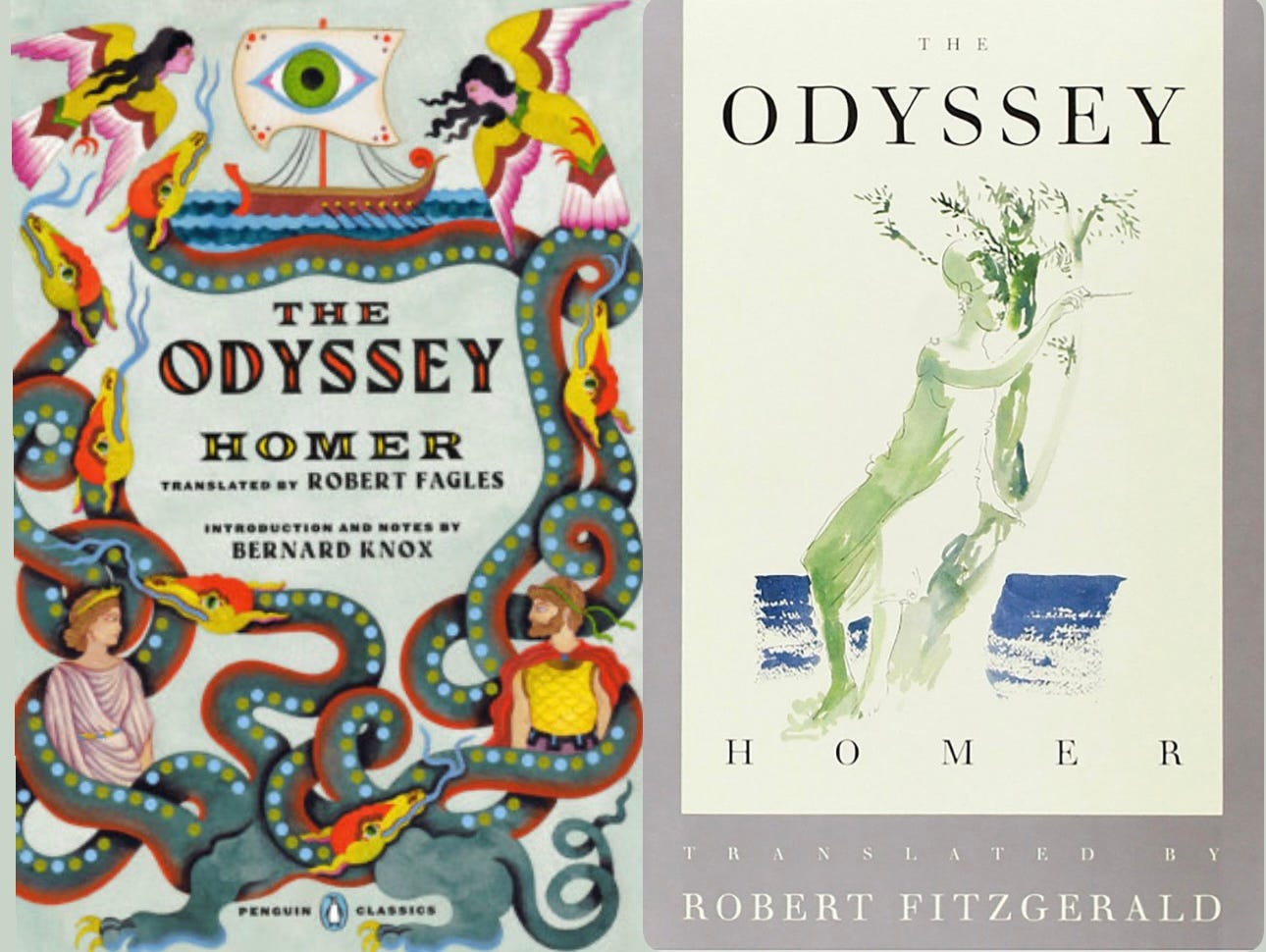
From the mid‑twentieth century on, verse translators map out a spectrum of “close” Homers in English, each attempting to balance fidelity to the Greek against the demands of a living contemporary poem. Richmond Lattimore, writing in the mid‑twentieth century, moves toward the structure and diction of the Greek, preserving its phrasing, syntax, and rhythms as much as possible in a restrained, line‑by‑line English verse. His language can feel formal, even remote, to contemporary readers, but that distance reflects a deliberate effort to keep the outlines of the Greek visible on the surface of the English. Later poetic translators such as Robert Fitzgerald, Robert Fagles, and Stanley Lombardo each make different compromises between literalness and readability, but they all take seriously the task of giving Homer a continuous, recognizably modern poem in English while acknowledging, more or less explicitly, his origins in oral performance. By the end of the twentieth century, English readers can choose among several such “close” Homers, occupying different points along that continuum.
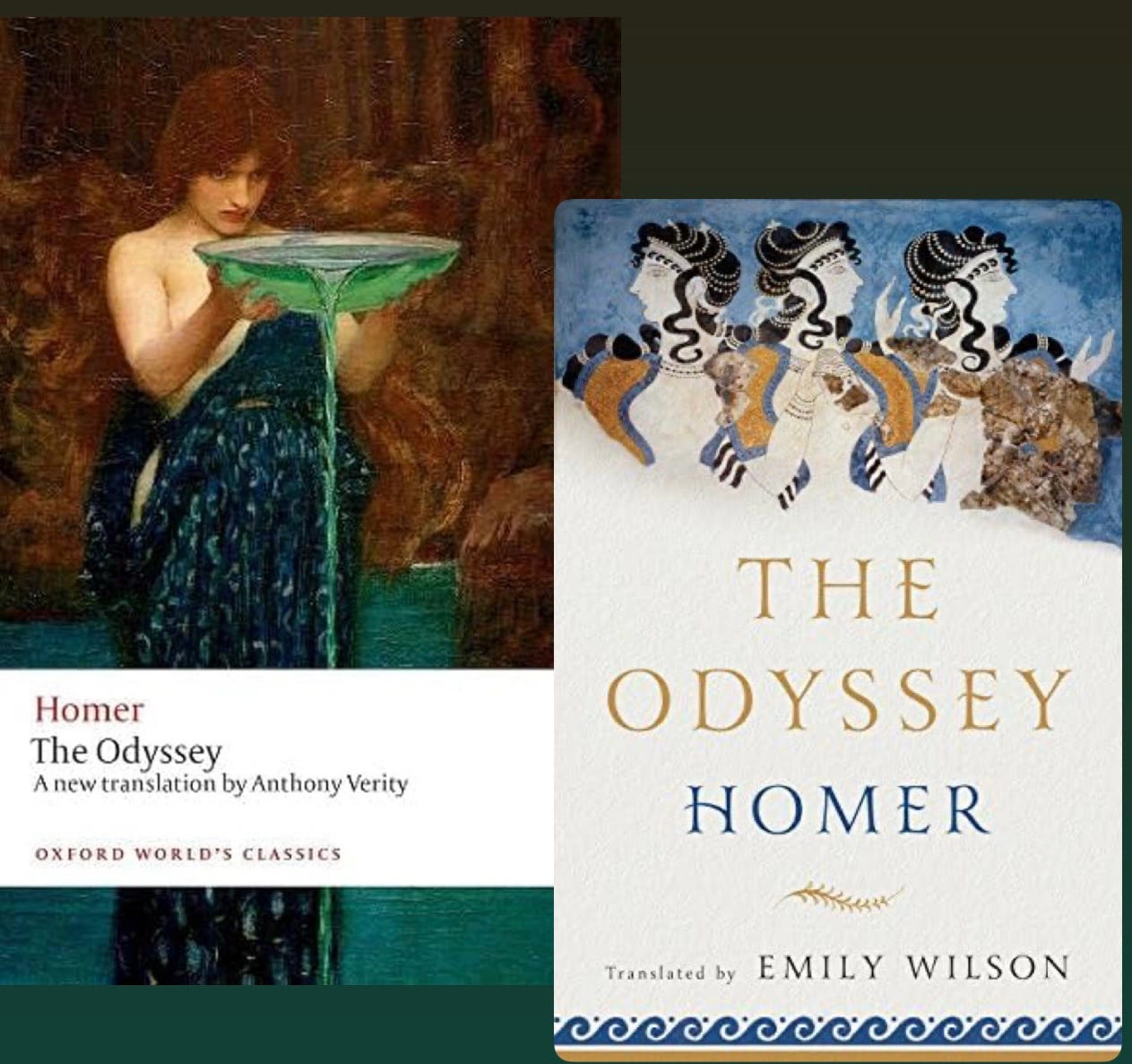
By the early twenty‑first century, when translators can no longer ignore Homer’s dual status as oral tradition and literary classic, this spectrum is dramatically epitomized in two widely read Odysseys that appeared within a year of each other. Anthony Verity makes the goal of closeness to the Greek explicit. He translates as close to line by line as possible in unmetered English, avoiding conspicuous poetic effects and aiming to let “Homeric directness” speak with minimal interference, so that his Odyssey can function both as a readable narrative and as a reliable guide for students and scholars. Emily Wilson, by contrast, offers an iambic‑pentameter poem that aims for “crystalline clarity” and a “nimble gallop.” She makes controversial choices about how far to streamline Homer’s style, all but eliminating the formulaic repetition and traditional epithets that mark Homeric epic as the remnant of a living song. In some places she stretches (e.g. rendering polymetis as “the lord of lies”) and at others she distorts (e.g. rendering pepnoumenos as “sullen” and “scolding”) Homeric words to fit her interpretive aims. Where Verity minimizes his own presence in the line so that Homer can “speak” through him, Wilson treats translation overtly as an act of creative rewriting, crafting an Odyssey that is openly shaped by her own ambitions and interpretive commitments.
In effect, Verity stands with the prose‑and‑education strand of the tradition, extending the Anne Dacier line into a modern, scholarship‑aware English, while Wilson revives the Chapman–Pope lineage of the translator as creative rival, fully aware of oral‑traditional scholarship but choosing to answer Homer with a new English poem. What unsettles many readers and scholars is not so much that she modernizes or redefines, but that she does so in full awareness of Homer as the trace of a communal, performative art, refiguring him decisively as a vehicle for an individual, contemporary voice. This tension is intensified by the way her version has often been marketed and adopted as an “academic translation,” which suggests a classroom‑ready, scholarly standard even as it pursues a strongly personal, poetic reimagining of the poem.
Once we acknowledge that the Homeric text is the surviving record of an oral performance tradition, the image of fidelity as finding the “right” equivalent style in English begins to look inadequate. The poems reach us as something like architectural fragments: walls and foundations from a lost building, still bearing the marks of ritual, performance, and communal use, but stripped of the living voice and setting that once held them together. Faced with such fragments, what does fidelity require? To reconstruct a whole new building in our own idiom, inspired by the old stones, or to present the remains as they are, with all their gaps and exposed joints, and let readers imagine what is missing?
Every translation must choose how much to domesticate Homer’s world and how much to leave it strange, and those choices touch not only on technique but on how we imagine the ancient world, what we want from epic in our own time, and who we think has the authority to speak for the past. To translate Homer in English verse is not, by itself, to be “faithful”; verse can just as easily domesticate him, replacing the strangeness of the Greek, and its traces of a sung, oral art, with the more familiar music of later English poetry. In many celebrated versions, the very features that make them satisfying poems in English also draw readers away from Homer’s Greek and toward an English epic tradition that has slipped into his place without our quite realizing it.
When readers defend Odysseys like Pope’s or Wilson’s as “faithful” largely because they are vivid, well‑made English poems in verse, they implicitly suggest that any powerful English epic that happens to use Homeric names and episodes could stand in for Homer himself. A similar assumption has surfaced in the discourse around Nolan’s Odyssey, with its emphasis on realism and authenticity of design: one vivid reconstruction is treated as if it could be the lost building itself. In both cases, there is a risk of mistaking a single rebuilding of the ruin for the whole of what has survived, and of forgetting that other ways of presenting the fragments, including more literal guides to the Greek, remain possible.
The question, in the end, is not only which Homer our translators and filmmakers construct. It is also whether we as readers and viewers can learn to recognize how far any given version has remade him, and how much of Homer’s strangeness and communal voice has been left behind, even as we attend to what it newly brings into view and to what no English Homer can finally recover.
In a subsequent three‑part series, I will be turning back to Homer in Greek: first to the Alexandrian scholars and the making of a “textual” Homer, then to Homer in the Greek Middle Ages, and finally to the ways Homer is read and heard in the modern Greek world.
For example, prefaces to collections like Thomas Percy’s Reliques of Ancient English Poetry and Walter Scott’s ballad work present traditional songs as “relics” of an earlier national imagination, and Romantic discussions of this material liken such ballads to a kind of “Homer” of the people, a communal epic voice rather than a single, named author.
Thanks for this — eye-opening. Now I better understand my frustration with the eddies, ripples and maelstroms on my library shelf, and how it makes me “delight my mind with lamentation.” Your insights into the daunting task of translation brought to mind Mark Twain: “A man who carries a cat by the tail learns something he can learn in no other way.”
Wasn't sure where you were going at first but 100% agree, for the most part, now I haven't read the first installment yet but I really do agree with you that I mean obviously we have to be well educated as to the period and the language and the author but you're right like our own influences our own feelings our own narrative invariably ends up in the translation but whether we couch that as part of the translation or admit that we purposely pushed it in a direction that we wanted it to go... that's the important part and it's honesty and and authenticity. If you do make a change you just have to be honest about it and I argue it should have at least a meaningful difference otherwise it's obfuscation? We all know that translation is as much interpretation.