
Abducting Helen
How ancient Athens claimed a foreign princess

By Eirene S. Allen
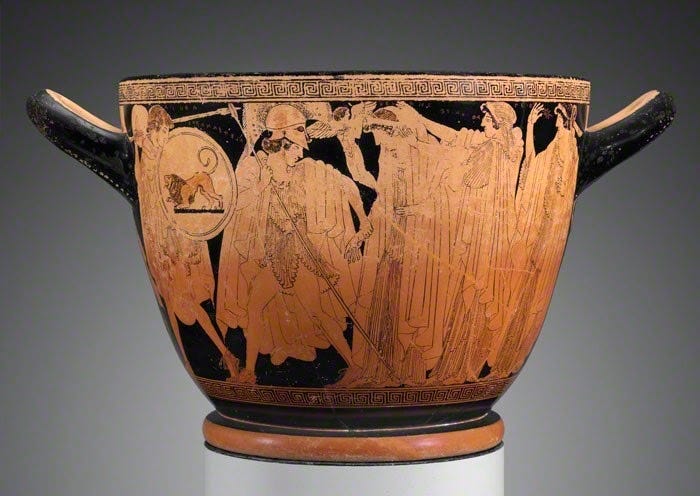
We are entering a season in which reviewers and publicists will insist how “Homeric” Christopher Nolan’s Odyssey is, a creative rival to the great bard himself. For many, seeing these stories return to the big screen provides genuine delight. But before we let our enthusiasm carry us away, it’s worth remembering that “Homeric” is not just a synonym for “grand” or “old”. For the ancient Greeks, myth was a way of telling the truth about their own world, anchored in ritual, place, and kinship.
In his Introduction to Selected Myths: Plato, Catalin Partenie eloquently expresses this simple but rich dynamic between story and reality,
“the primordial deeds of the gods, those that caused the world around us to be as it is, were out of our reach, for they happened at the beginning of time. But they have been preserved in words, in stories that can make us witness them anew. These stories that recreate the very creation of the world by the gods, and thus unveil the ultimate origin of reality, were called by the ancient Greeks ‘myths’.”
Myth, in this sense, is anchored in history, not our documentary history, but the truths a culture has identified about itself and inscribed in narrative, and those truths were re‑created at the intersection of story and ritual. Memory is thus achieved on two planes: in story and in action. A myth names a truth about the world; ritual lets a community step into that truth for a moment, in bodies and movement as well as in words.
Within this world, some mythic figures, the ones we call Panhellenic, traveled across the borders of city‑states, living for a time in Athens, Sparta, Thebes, and elsewhere; others were stubbornly local, rooted in their own native soil but embodying patterns familiar across the Greek world. Helen belongs to the first group: a Panhellenic figure whose broader pattern as an object of desire repeatedly abducted and contested is spun into many different versions. In Athens, it acquires a local tale of kidnapping, concealment, and negotiated return. Precisely because her same broad story‑pattern is reworked, Helen becomes a useful figure for exploring myth as truth‑telling about each community that claims her.
In Attic tradition, Helen enters the city’s story as a foreign princess briefly absorbed into the Athenian landscape when its king Theseus abducts her. Older accounts place her dancing as a young girl in a Spartan sanctuary of Artemis when Theseus seizes her, carries her away, and hides her at Aphidna, a village on the northern edge of Attica. Discovering her abduction, her twin brothers, the Dioskouroi, raise an army, cross into Attica, and demand her return; when the Athenians deny knowledge of her whereabouts, the twins resort to war. They storm Aphidna and take their sister back, leaving the land ravaged and the local political order shaken.
A local Attic hero, Academus steps into this story with a small but memorable role: knowing where Helen is concealed, he reveals her location to the Dioskouroi and thereby spares Athens a fuller destruction. Later tradition reports that the Spartans, in gratitude, always spared his grove when they invaded Attica, and that this same grove, later known as the Academy, became the site of Plato’s school, which took its name from a landscape already marked by the search for an abducted girl. In Attica, then, Helen’s story is told as a sequence of kidnap, concealment and armed retrieval, with local heroes and neighborhoods woven into a tale of foreign beauty, civic risk, and negotiated rescue.
We can see how this local variant echoes Helen’s Panhellenic fame: a great beauty carried off, a demand for her return refused, and war unleashed in the name of bringing her back. This story‑theme threads through both Athens’ myth and the epic narratives that speak for all Greeks, so that the little Attic Helen at Aphidna becomes a local echo of the Panhellenic Homeric Helen. At the Great Panathenaea, the festival itself stages this double focus: women spend months at the loom, drawing out the peplos for Athena Polias thread by thread with scenes of gods and Giants locked in battle, while rhapsodes stitch Homer’s verses together in performance to retell the epic war over Helen. Even when the details change, Helen’s pattern of being carried off and fought over emerges as the common thread that runs through her stories. In that intersection of epic and local, the polis weaves its own dangers and rescues into the fabric of Panhellenic myth.
Athens’ story of Helen leaves traces in cult. When second century AD traveller Pausanias walks Attica in a quest to document the memories of a conquered people, he notes that the Dioskouroi had a shrine tied to this very story: Theseus’ abduction, the brothers’ invasion, the storming of Aphidna, and the recovery of Helen. The shrine itself is for the twins, set in the network of northern neighborhoods and hero‑shrines that ring the city, but its foundation‑legend is explicitly a tale about their sister, so that Helen’s presence in Athenian sacred space is mediated through family cult. Pausanias also preserves the political after‑effects within the mythic episode: he reports that Theseus’ seizure of Helen helped fuel internal conflict. Rival Athenian aristocrat Menestheus, who would briefly displace Theseus as king, persuaded the Athenians to welcome the Dioskouroi as benefactors against their own ruler. In Pausanias’ telling, that welcome links foreign princess and local politics, so that they are remembered together in the same story. We do not know what specific ritual acts, if any, were directed to Helen herself at Athens, but the cult of her brothers and the honour for Academus show how her abduction was anchored in the city’s religious and civic memory: a dangerous beauty briefly claimed, then violently relinquished, leaving shrines, groves, and political realignments in its wake.
Beyond Attica, Helen’s cult life is perhaps better known, particularly in Sparta. There, she and Menelaos share a hero‑shrine at Therapne, above the Eurotas, where literary and archaeological work points to a long‑lived cult concerned with marriage, fertility, and the prosperity of the community. Elsewhere, cities give her local epithets in highly specific landscapes: on Rhodes, she appears as Helen Dendritis, “of the tree” with a sanctuary that remembers her as a figure bound to a tree and to the community’s need to expiate an earlier wrong. Taken together, such sites sit alongside more fragmentary traces: images of Helen between the Dioskouroi, hints of her in marriage and fertility contexts. Across the Greek world, she thus flickers between foreign princess, local tree‑goddess, and civic heroine, her myth refracted through different cityscapes.
Modern work on heroine cults and on Helen specifically has used these scattered traces to think about how Greek communities domesticate foreign princesses in their own religious landscapes. Helen’s cults show how a girl whose story travels across the Greek world can be anchored in local kinship and ritual, turned from outsider into participant in family and civic life. Scholars like Jennifer Larson and Deborah Lyons point out that heroines are very often rooted in kinship networks as sisters, wives and mothers and that their cults cluster around family bonds and marriage more than solitary, free‑standing female shrines. Helen fits this pattern: in Sparta she is honoured with Menelaos at Therapne, in Attica she is remembered through her brothers at Aphidna and the Dioskouroi’s shrine, and on Rhodes she appears as Helen Dendritis in a local tale that turns a foreign queen into the centre of a community’s attempt to settle an old wrong. What these cults suggest collectively is that “domesticating” Helen meant binding a dangerous, foreign beauty into specific lines of kinship and ritual, so that each city could turn her story into part of its own ongoing truth about family, risk, and survival.
Helen arrives in myth already marked as an outsider, a Spartan or Laconian woman whose movements across borders trigger wars, but local cults in Attica, Laconia, and Rhodes make her part of family and civic life, entwining her body and story with neighborhoods, shrines, groves, and ritual calendars. Once we see how a “foreign princess” is brought in from the edges of the world and sewn into the fabric of a particular city, a different question suggests itself. Instead of asking only how “Homeric” Nolan’s film is, we might ask: what story is his Odyssey telling us about our own world, and about the way we treat “foreign princesses”? It is a question worth keeping in mind as we watch, and worth returning to at the end of any review that calls his film “Homeric”.
Eirene S. Allen is the director of the Institute for Classics Educationand the author of The Epic Women of Homer.
I like the different origin stories of Helen. Fascinating!
So very interesting and so well written .Fascinating that there is so much more to these stories than the normal reader realises .